Cybersecurity & Defense Readiness
We help organizations assess, test, and improve their cybersecurity posture through practical security testing, maturity assessment, governance enhancement, third-party risk management, and enterprise security strategy.
A resilient organization does more than respond to cyber threats. It understands its risks, strengthens its defenses, and builds trust into the way technology supports the business.
As organizations rely more on digital platforms, cloud services, third parties, and connected systems, cybersecurity must go beyond compliance. It must enable confidence, protect critical operations, and support sustainable growth.
We help organizations strengthen their cybersecurity and defense readiness through practical assessment, security testing, governance improvement, and risk-based advisory. By combining cybersecurity expertise with business and regulatory understanding, we help clients identify weaknesses, improve resilience, and make informed decisions in the face of evolving threats.
Our goal is to help you build a secure, trusted, and resilient digital environment so your organization can move forward with confidence.


How can we help
Penetration Testing
Vulnerability Assessment


Gain visibility of known security weaknesses across applications, systems, networks, cloud, and infrastructure. We classify and prioritize findings by risk level, enabling teams to remediate issues efficiently and reduce overall cyber exposure.
Simulates real-world attack techniques to validate whether weaknesses can be exploited. We perform controlled, risk-based testing to assess potential impact, uncover attack paths, and provide practical remediation guidance.
Security Maturity Assessment
Understand the current cybersecurity maturity, identify key gaps, and prioritize improvements through a practical roadmap that strengthens security and supports better risk-based decisions.
Security Governance Program
Third Party Security Assessment


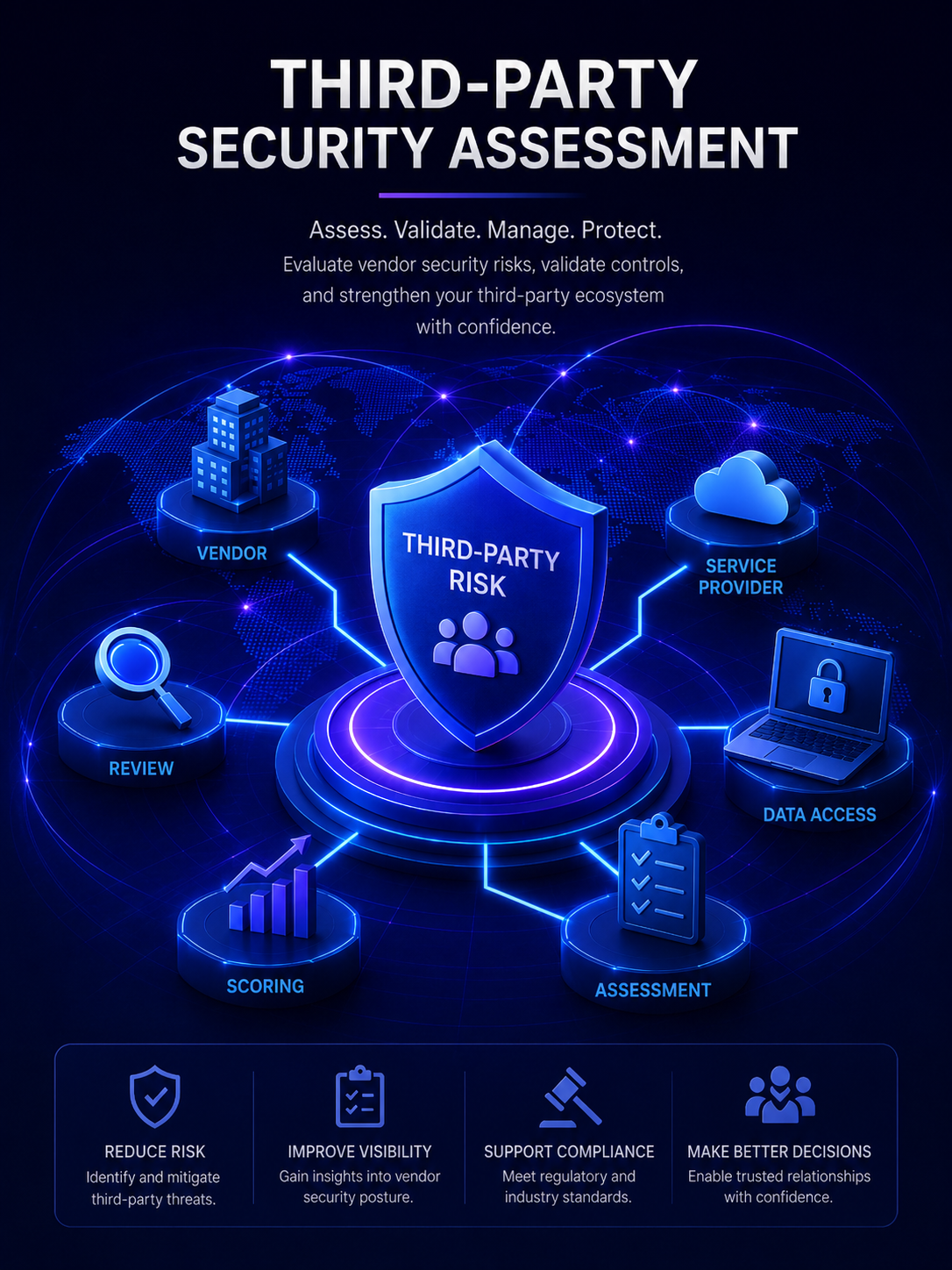
Evaluate the cybersecurity posture of vendors, service providers, cloud providers, and outsourcing partners to identify key risks, validate security controls, and support safer third-party engagements.
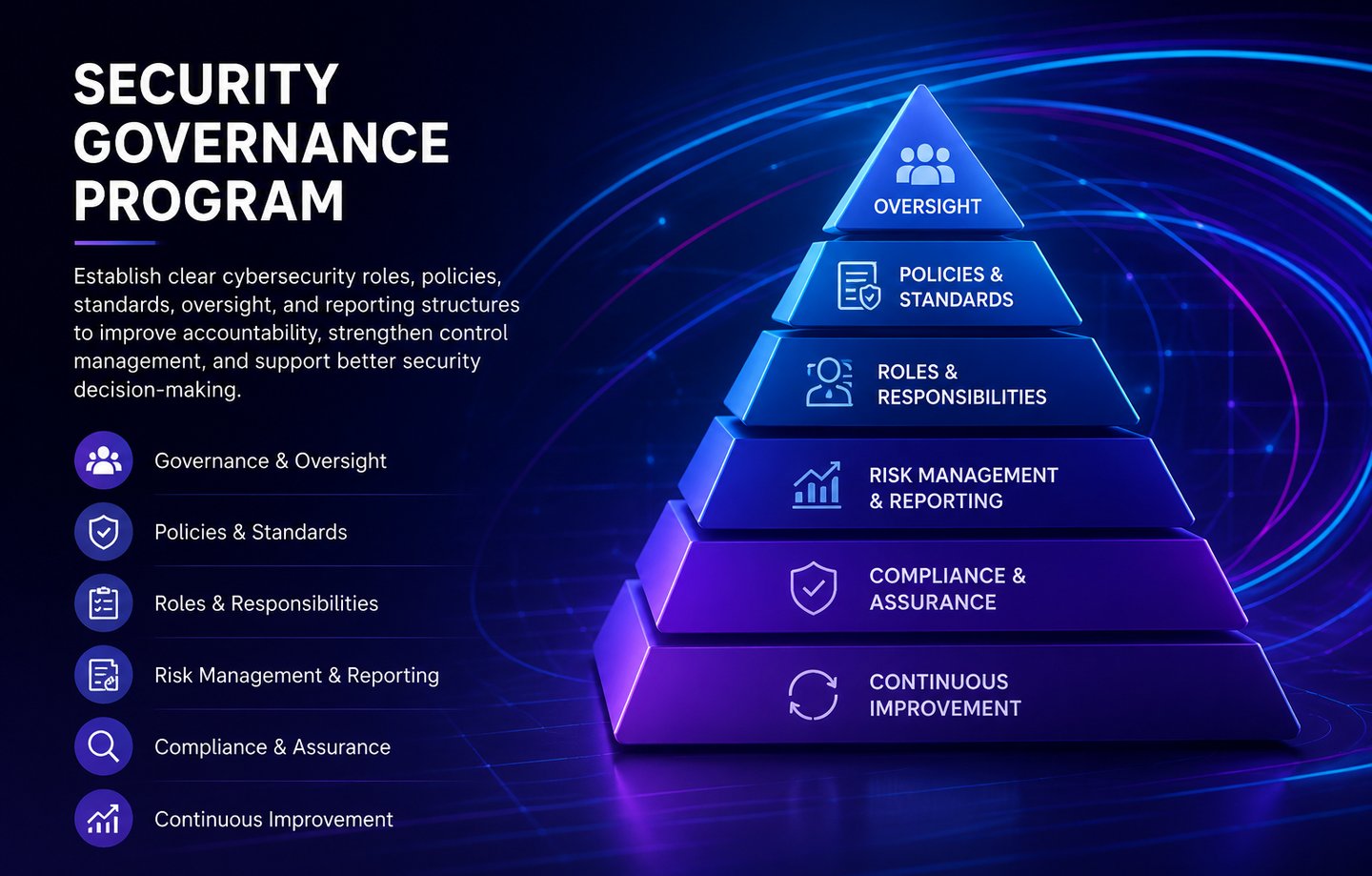
Establish clear cybersecurity roles, policies, standards, oversight, and reporting structures to improve accountability, strengthen control management, and support better security decision-making.
Enterprise Security Strategy
Help establish a clear cybersecurity direction aligned with business priorities, risk appetite, and regulatory expectations, with a practical roadmap to strengthen resilience and guide security investment.
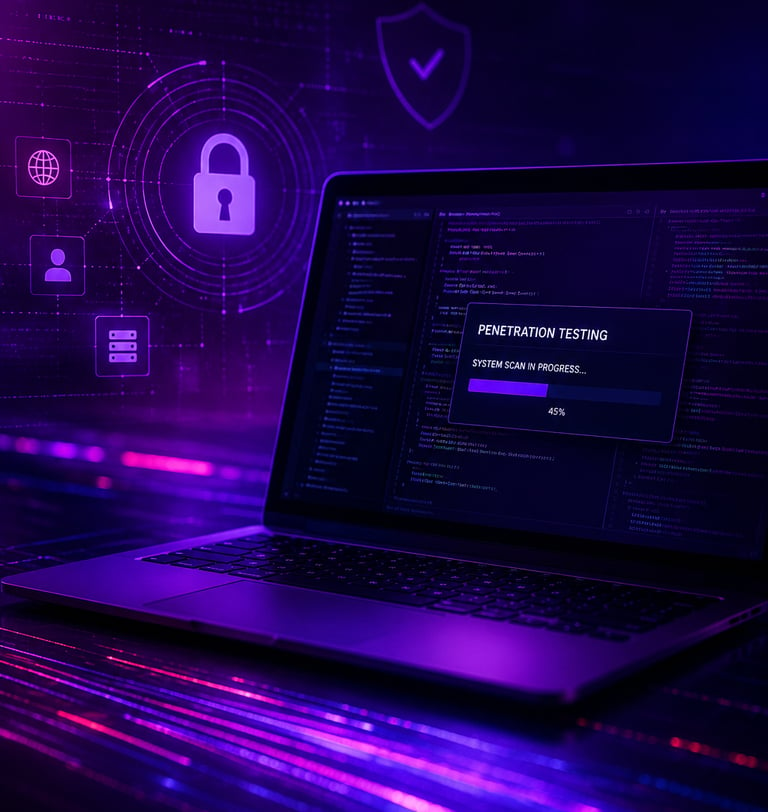
Penetration Testing helps organizations understand how real attackers could exploit weaknesses in their applications, networks, cloud environments, and infrastructure. Through controlled and risk-based testing, we identify exploitable vulnerabilities, assess potential impact, and provide practical remediation guidance to strengthen security posture.
Why It Matters
Security weaknesses are often hidden until they are exploited. Penetration Testing provides a controlled way to validate security controls, uncover attack paths, and understand the real-world impact of vulnerabilities before they lead to business disruption, data exposure, or regulatory concern.

Penetration Testing
Penetration Testing Scope
Our Penetration Testing service can be tailored to the organization’s environment, risk priorities, and business objectives. Possible scope may include:
Web application penetration testing
API security testing
Mobile application testing
External network penetration testing
Internal network penetration testing
Cloud environment testing
Infrastructure and server testing
Wireless security testing
Segmentation and access control validation
Social engineering or phishing simulation, where applicable
Penetration Testing Approach and Methodology
We follow a structured and controlled penetration testing approach to ensure each engagement is safe, focused, and aligned with the agreed scope, business context, and risk priorities.
1. Scope & Testing Model
We define the objectives, in-scope assets, testing boundaries, rules of engagement, communication protocols, and testing model. Depending on the assessment objective, testing may be conducted as:
Black Box Testing — performed with little or no prior knowledge to simulate an external attacker’s perspective.
Grey Box Testing — performed with limited information or user-level access to balance realistic attack simulation with efficient risk identification.
White Box Testing — performed with detailed knowledge, such as architecture, configurations, source code, or privileged access, to enable deeper technical validation.
2. Information Gathering & Analysis
We collect and analyze relevant information about the target environment to understand the attack surface, identify potential entry points, and assess likely attack paths.
3. Vulnerability Identification
We identify potential weaknesses through manual testing, security tools, configuration review, and techniques relevant to the agreed scope.
4. Controlled Exploitation
Where permitted, we safely validate whether identified weaknesses can be exploited and assess how far an attacker could progress within the environment.
5. Impact Assessment & Risk Prioritization
We assess the potential technical and business impact of successful exploitation, including unauthorized access, privilege escalation, lateral movement, or sensitive data exposure. Findings are prioritized based on risk, exploitability, and business context.
6. Reporting & Remediation Guidance
We provide clear findings, evidence, risk ratings, and practical remediation recommendations to support timely action by technical and management teams.
7. Retesting, Where Required
We can perform retesting to confirm whether agreed remediation actions have effectively addressed the identified issues.
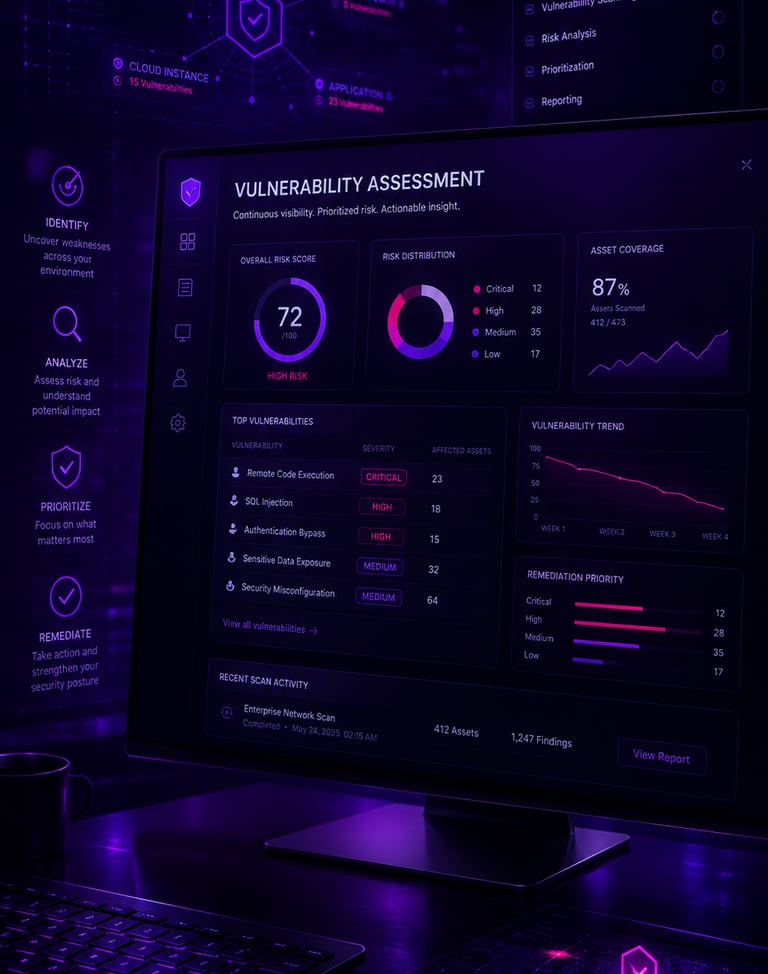
Vulnerability Assessment helps organizations gain visibility of known security weaknesses across applications, systems, networks, cloud environments, and infrastructure. The assessment identifies vulnerabilities, misconfigurations, outdated components, and exposure points, then prioritizes them based on risk so teams can focus remediation efforts where they matter most.
Why It Matters
Organizations often have many vulnerabilities across their technology environment, but not all issues carry the same level of risk. A Vulnerability Assessment helps separate critical issues from lower-priority findings, enabling teams to take timely, risk-based action and improve overall security hygiene.

Vulnerability Assessment
Our Approach
1. Scope & Asset Identification
We define the assessment scope, target systems, environments, and asset groups to be reviewed.
2. Vulnerability Discovery
We identify known vulnerabilities, misconfigurations, outdated components, and exposed services using appropriate assessment tools and review techniques.
3. Validation & Analysis
We review and validate findings to reduce false positives and understand the relevance of vulnerabilities within the client’s environment.
4. Risk Prioritization
We prioritize findings based on severity, exposure, affected assets, likelihood, and business context.
5. Reporting & Remediation Guidance
We provide clear findings, risk ratings, affected assets, and practical remediation recommendations.
6. Reassessment, Where Required
We can perform follow-up assessment to confirm whether key vulnerabilities have been addressed.
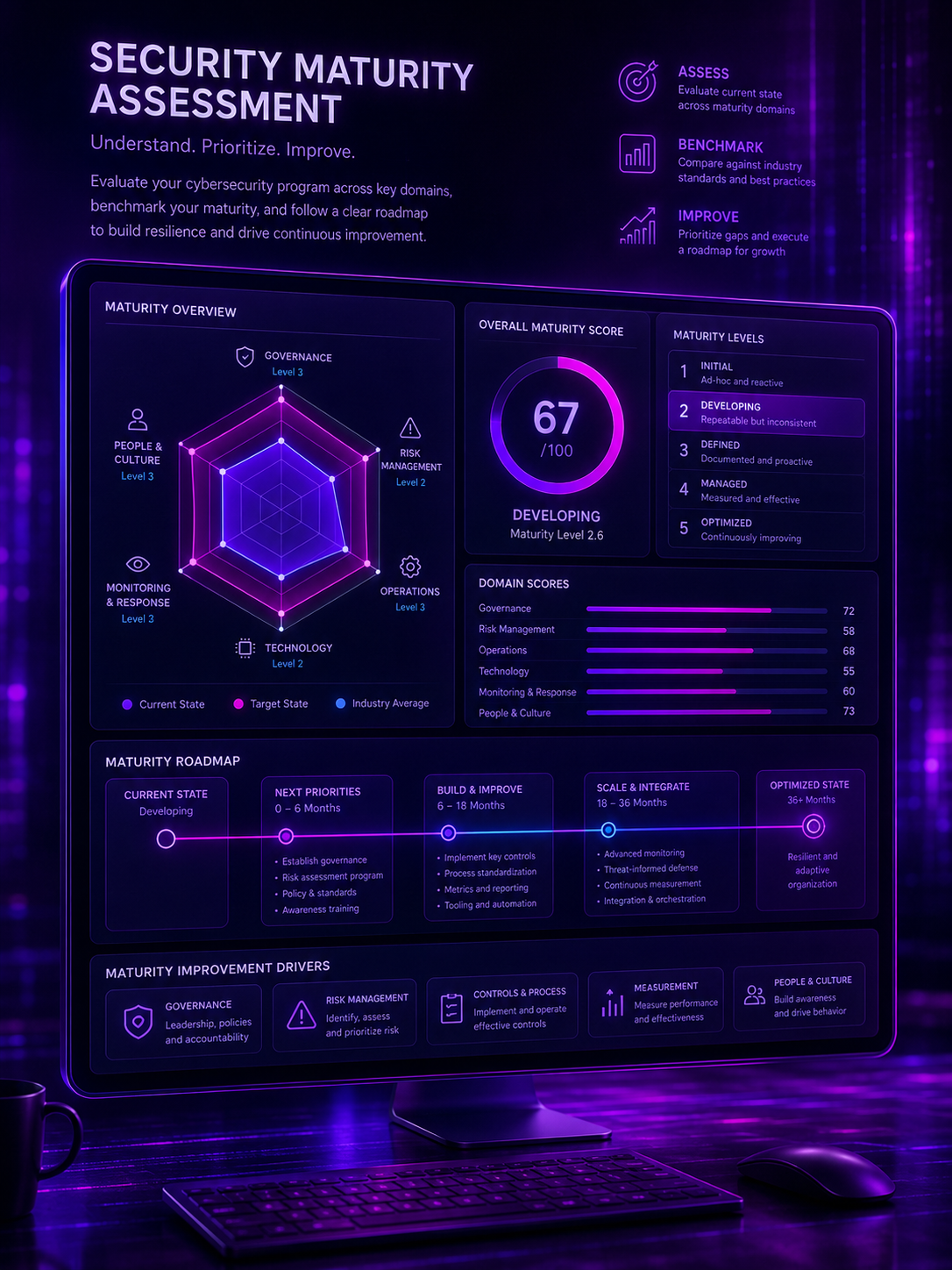
Cybersecurity maturity is about more than individual controls. It reflects how well an organization governs security, manages risk, responds to threats, protects critical assets, and continuously improves over time.
Our Security Maturity Assessment helps organizations understand where they are today, where they need to be, and what actions should be prioritized next. We assess current cybersecurity capabilities against recognized frameworks and good practices, then translate the results into a practical improvement roadmap.
Why It Matters

Security Maturity Assessment
What We Assess
The assessment can be tailored to the organization’s environment, industry, and risk priorities. Key areas may include:
Cybersecurity governance and oversight
Security policies, standards, and procedures
IT and cyber risk management
Identity and access management
Security operations and monitoring
Vulnerability and patch management
Incident response readiness
Data protection and privacy controls
Cloud and infrastructure security
Third-party security risk
Security awareness and culture
Regulatory and compliance alignment
How We Support You
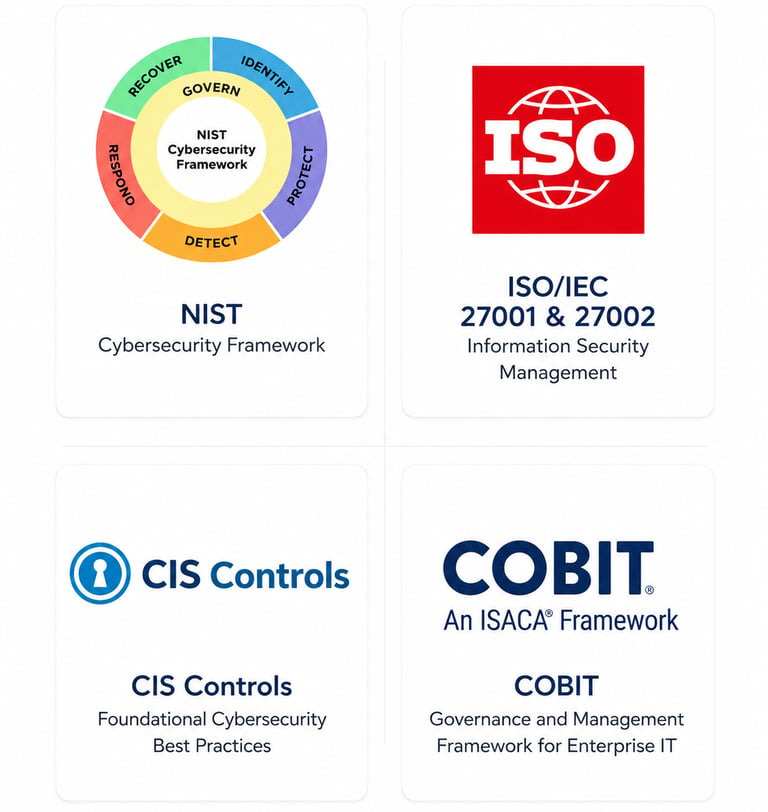
We help management and security teams move from uncertainty to a clear improvement plan by assessing cybersecurity maturity against recognized frameworks, standards, and industry good practices. The assessment approach can be aligned with frameworks such as NIST Cybersecurity Framework, ISO/IEC 27001 and 27002, CIS Controls, COBIT, and relevant regulatory or industry requirements, depending on the organization’s business context, risk profile, and compliance expectations.
Establishing the current maturity baseline
We assess how cybersecurity capabilities are currently designed, implemented, and operating across key domains.
Aligning with recognized best practices
We benchmark current practices against selected cybersecurity frameworks, standards, and regulatory expectations to provide a structured and credible assessment.
Identifying gaps and improvement areas
We highlight weaknesses, inconsistencies, and areas that may create risk exposure, operational concern, or compliance gaps.
Prioritizing based on business risk
We help prioritize improvement areas based on impact to resilience, critical operations, regulatory relevance, and management oversight.
Developing a practical roadmap
We provide recommended initiatives, quick wins, and longer-term actions to support sustainable cybersecurity improvement.
Security Maturity Assessment helps organizations gain a clear view of their cybersecurity current state, make better risk-based decisions, prioritize security investment, and build a practical roadmap to strengthen resilience over time.

Why It Matters
Without strong governance, cybersecurity can become fragmented, inconsistent, and difficult to measure. A clear governance program helps organizations improve accountability, align security with business risk, support regulatory expectations, and make better decisions on security priorities and investments.

Security Governance Program
How we help
We help organizations design and implement a practical cybersecurity governance program by turning governance requirements into clear structures, documents, and operating practices.
Governance structure design
We define the appropriate security governance model, including committees, reporting lines, escalation paths, and decision-making responsibilities.
Roles and accountability mapping
We clarify responsibilities across management, security teams, IT teams, business units, risk owners, and control owners through a clear accountability model or RACI.
Policy and standard development
We help create or enhance cybersecurity policies, standards, procedures, and control requirements to ensure they are practical, consistent, and aligned with business and regulatory expectations.
Risk and control ownership
We support the definition of risk ownership, control ownership, control monitoring responsibilities, and governance touchpoints for managing cyber risks effectively.
Reporting and oversight setup
We design management reporting, board-level reporting, KPIs, KRIs, dashboards, and governance meeting structures to support better oversight and decision-making.
Compliance and assurance alignment
We align the governance program with relevant frameworks, regulatory requirements, internal audit expectations, and assurance activities.
Improvement roadmap
We provide a prioritized roadmap with quick wins and longer-term actions to strengthen governance maturity over time.
Why It Matters

Third Party Security Assessment
What it is
Third-Party Security Assessment helps organizations evaluate the cybersecurity posture of vendors, service providers, cloud providers, outsourcing partners, and other external parties that may access systems, data, or support critical business operations.
How We Support You
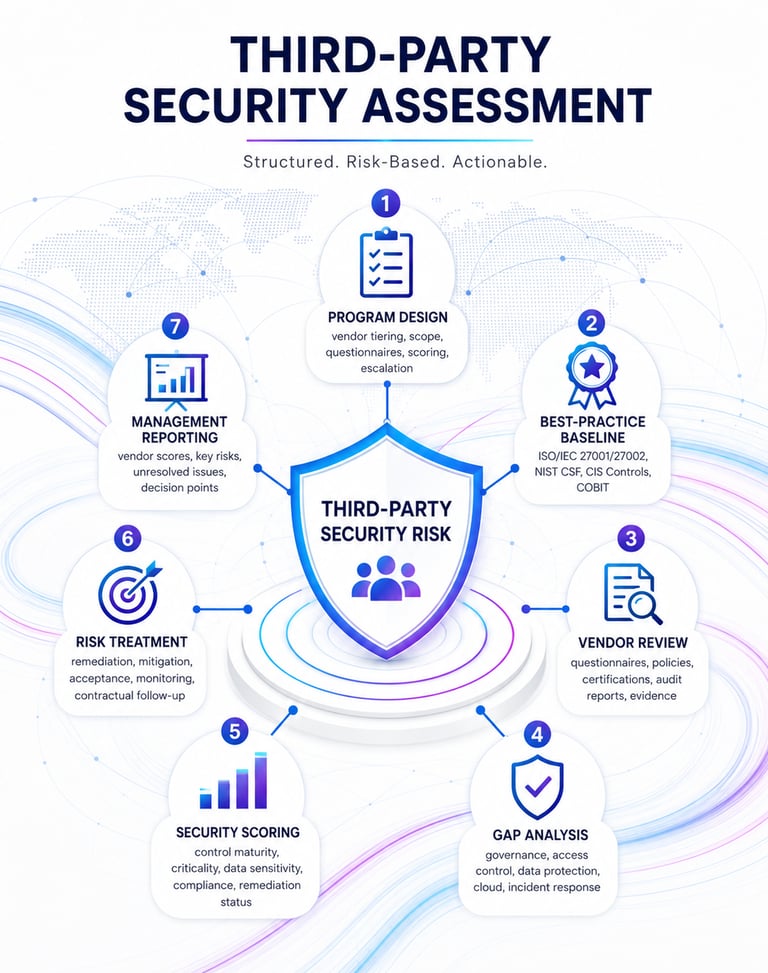
We help organizations assess and manage third-party security risk through a structured, risk-based assessment approach.
Risk-based assessment program design
We help design or enhance the third-party security assessment program, including vendor risk tiering, assessment scope, questionnaire structure, evidence requirements, review workflow, scoring criteria, and escalation process.
Baseline against recognized practices
We assess vendor security controls against relevant frameworks, standards, and good practices such as ISO/IEC 27001 and 27002, NIST Cybersecurity Framework, CIS Controls, COBIT, and applicable regulatory or contractual requirements.
Vendor security review
We review vendor questionnaires, policies, certifications, audit reports, security documents, architecture diagrams, incident response procedures, business continuity plans, and supporting evidence.
Security control gap analysis
We identify gaps across key areas such as security governance, access control, data protection, cloud security, vulnerability management, incident response, logging and monitoring, business continuity, and third-party subcontractor management.
Security scoring and risk rating
We help develop a security score or risk rating model to provide a consistent view of vendor risk. Scores can consider control maturity, data sensitivity, service criticality, connectivity, compliance requirements, and remediation status.
Remediation and risk treatment guidance
We provide practical recommendations, required remediation actions, and suggested risk treatment options such as mitigation, acceptance, monitoring, contractual follow-up, or management approval.
Management reporting
We summarize key risks, assessment results, vendor scores, unresolved issues, and decision points to support onboarding, renewal, ongoing monitoring, and management oversight.
Third parties can introduce significant cybersecurity risk through access to sensitive data, system connectivity, outsourced operations, cloud services, or critical business support. Weak vendor controls may lead to data exposure, service disruption, regulatory issues, or reputational damage. Assessing third-party security helps organizations understand these risks before onboarding, contract renewal, or continued engagement.

Proactive Vendor Assurance
Having third parties acknowledge and comply with the organization’s security policy is an important control. However, acknowledgement alone may not provide sufficient visibility into how security controls are actually designed, implemented, and operating.
Third-Party Security Assessment adds another layer of protection by taking a more proactive approach. It helps organizations validate vendor security practices, identify control gaps, and understand potential risks before they result in data exposure, service disruption, or compliance issues.
Contact US
Leave your email for business contact, we will reach out to you asap!
info@tir-advisory.com
+66 95 582 9976
© 2025 by TIR Advisory Co. Ltd. All rights reserved.